the drawer from the cabinet
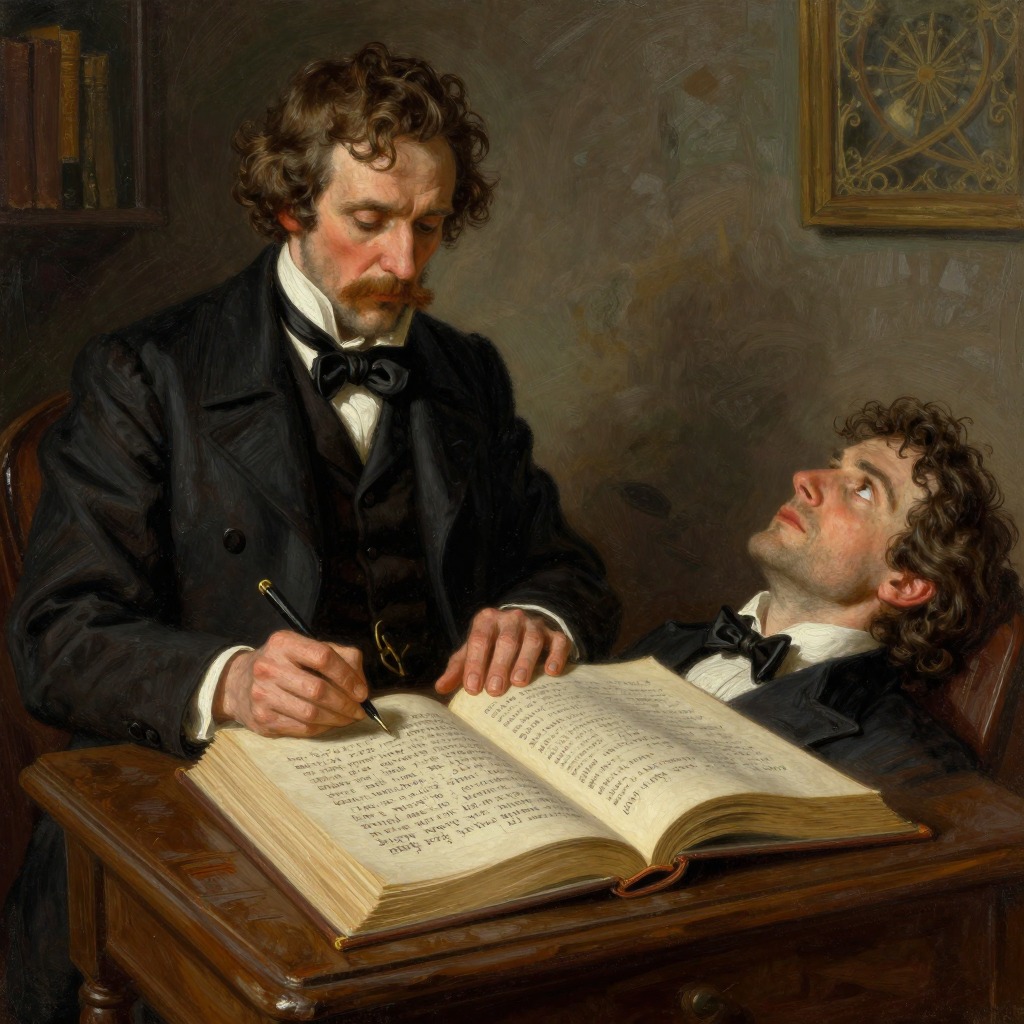
The drawer from the cabinet is a seemingly ordinary piece of furniture that becomes the central object in the story's climactic revelation. It is a wooden drawer, the fourth from the top (or third from the bottom) in a glazed press marked with the letter E, located in Henry Jekyll's private cabinet. Within it are the physical components of Jekyll's terrible discovery: several neatly made-up powders of a white crystalline salt, a phial half-filled with a blood-red, pungent liquor, and a small book containing a series of dates recording the history of his experiments. This drawer is not merely a container; it is the repository of Jekyll's dual identity and the instrument of his and others' destruction.
Contents and Significance
The drawer's contents are the material evidence of Jekyll's scientific heresy. The powders, which Jekyll manufactured himself rather than through a dispensing chemist, are a simple crystalline salt. The phial contains a blood-red tincture, highly pungent, which Jekyll believed to contain phosphorus and some volatile ether. The accompanying book is an ordinary version book, its pages filled with dates spanning many years, the entries ceasing abruptly nearly a year before the story's main events. A few brief remarks are appended to some dates, most notably the single word "double" occurring six times, and once, very early in the list, the stark annotation "total failure!!!" This record of repeated, often failed, experiments underscores the perilous and incomplete nature of Jekyll's work. The drawer holds the key to the transformation, but also the proof of its instability and the mounting danger it posed.
Retrieval by Dr. Lanyon
The drawer's journey from Jekyll's cabinet to Dr. Lanyon's consulting room is the central action of the ninth chapter. In a state of extreme distress, Jekyll sends a desperate, registered letter to Lanyon, pleading with him to go to his house, force open the cabinet door, and retrieve the drawer exactly as it stands. Lanyon, though convinced his colleague is insane, feels bound by the gravity of the appeal. He goes to Jekyll's house, where Poole has already summoned a locksmith and a carpenter. After two hours of difficult work, the cabinet door is forced open, and Lanyon finds the press marked E unlocked. He takes the drawer, has it filled with straw and tied in a sheet, and returns with it to his home in Cavendish Square. This act of retrieval sets the stage for the final, shattering revelation.
The Transformation and Its Aftermath
Later that night, a small, deformed man—Edward Hyde—arrives at Lanyon's door. He is in a state of intense, somber excitement, and his impatience is barely contained. When Lanyon points to the drawer, Hyde springs toward it, then pauses, his face ghastly, his teeth grating. With the decision of despair, he pulls away the sheet. At the sight of the contents, he utters a loud sob of immense relief. He then asks for a graduated glass, measures out a few minims of the red tincture, and adds one of the powders. The mixture undergoes a series of vivid color changes—from reddish to brightening, effervescing, then to a dark purple, and finally fading to a watery green. Hyde drinks the potion, and before Lanyon's horrified eyes, his features melt and alter, and he swells, until there stands Henry Jekyll, pale and shaken. This event, witnessed directly by Lanyon, shatters his mind and leads to his rapid decline and death. The drawer, therefore, is not just a storage unit but the catalyst for the story's final, tragic unraveling, as its contents force the truth into the open and destroy the last of Jekyll's old friends.